Canada spoils park lovers. Jasper, Banff, Waterton, the Gulf Islands, the wild interior of British Columbia: we have more protected wilderness per capita than almost anywhere on earth, and most of us haven’t seen a fraction of it. That’s the good news. The slightly humbling news is that there are protected natural environments in other parts of the world that operate on a completely different ecological register, and experiencing them changes how you think about what a national park can be.
Moreton Island, off the coast of Queensland, Australia, is one of them. The island is almost entirely national park, it’s the third-largest sand island on earth, and the marine environment surrounding it is part of the Moreton Bay Marine Park, one of the largest protected marine areas in Australia. For anyone who has spent serious time in Canadian parks and wants to understand what subtropical island conservation looks like, Moreton Island is the destination.
Here are eight reasons it belongs on the list.
1. The Island Is 98% National Park
Moreton Island covers about 186 square kilometres. Of that, all but a small settlement at Tangalooma and a few camping areas is protected national park land. There are no paved roads on the island. There are no shopping centres, no resort strips, no tourist infrastructure in the usual sense. What exists is sand, scrub, wetland, forest, and coast, protected under Queensland national parks legislation and managed for conservation rather than development.
For Canadian park visitors accustomed to the tension between conservation and commercial development that plays out in places like Banff, where the town and the park coexist in complicated ways, Moreton Island represents a different model. The protected status is near-total, and the experience of being there reflects that. The island feels wild in a way that destinations with higher visitor infrastructure rarely manage.
2. The Sand Dunes Are Among the Largest in the Southern Hemisphere
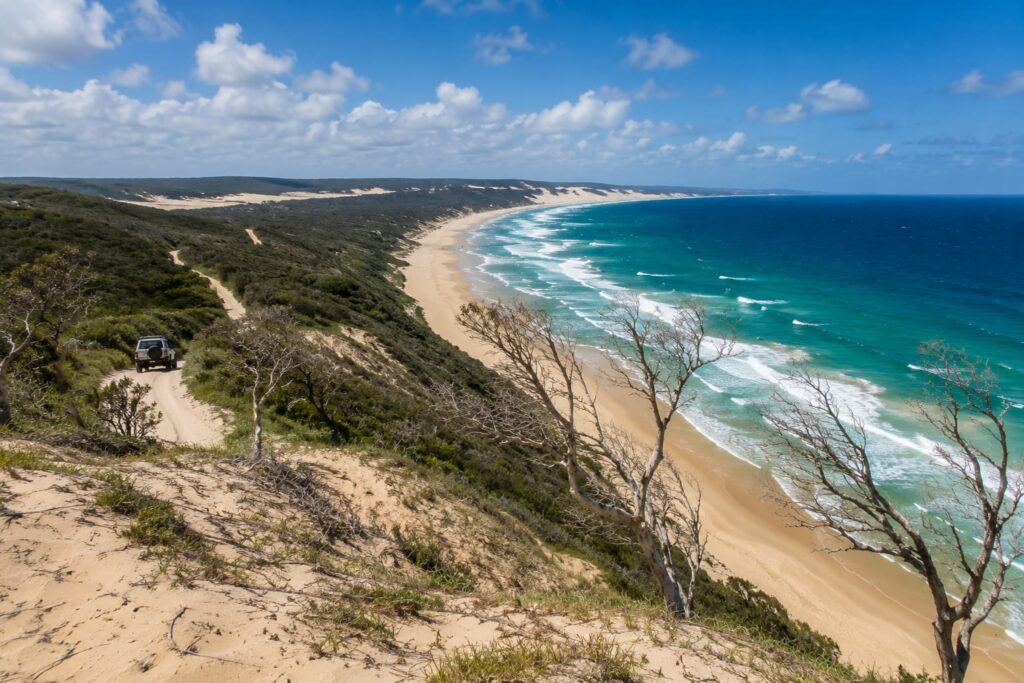
The interior of Moreton Island is dominated by sand dunes, some reaching over 280 metres above sea level. Mt. Tempest, the island’s highest point, is the tallest stabilised coastal sand dune in the world. The dune landscape is not the flat, featureless terrain the word “sand” might suggest. It’s a varied, rolling environment of forested dune slopes, exposed sand faces, and interdunal wetlands that support a range of plant communities adapted to one of the most nutrient-poor substrates in ecology.
Hiking through the dune country gives you a sense of scale and terrain variety that catches most visitors off guard. Canadians used to thinking of dunes as a minor coastal feature, something at the edge of a beach rather than a defining landscape element, tend to recalibrate quickly when they’re standing on a forested dune slope looking out over 20 kilometres of open ocean.
3. The Freshwater Lakes Are a Geological Wonder
Moreton Island has several freshwater lakes perched in the dunes, formed not by catchment drainage but by a process called perched lake formation: organic matter accumulates in dune hollows, creating an impermeable layer that traps rainwater above the surrounding water table. The result is lakes of exceptional clarity, filled entirely by rainfall, with no inflowing streams and no connection to groundwater.
Blue Lagoon, the largest of these perched lakes, sits in the northern part of the island and is accessible on foot from the beach. The water is clear enough to see the sandy bottom at several metres depth. Swimming in it feels different from swimming in lake water connected to a broader catchment, cleaner and somehow more isolated, which is exactly what it is. For park visitors interested in the ways geology produces unexpected hydrological features, this is a good one to add to the mental collection alongside Canadian examples like the kettle lakes of the Prairie provinces.
4. The Tangalooma Wrecks Make for World-Class Snorkelling
In the 1960s, fifteen decommissioned vessels were deliberately sunk in the shallow water off Tangalooma to create a breakwater for small boats. Over the decades since, the wrecks have become one of the most biodiverse artificial reef systems in Queensland. Coral, sponge, and soft organisms have colonised the hulls. Fish communities have established themselves in the structure. The snorkelling above and around the wrecks is accessible to beginners and rewarding enough to keep experienced divers interested.
The visibility in Moreton Bay, while variable with tidal conditions, can be exceptional on calm days. The wreck reef sits in water shallow enough that even non-swimmers can view the upper sections from the surface. It’s one of those situations where human error, in this case the need to dump old ships somewhere, produces an ecological benefit that takes on a conservation value of its own over time. The wrecks are now protected.
5. The Wild Dolphin Feeding Program Is One of the Most Accessible Wildlife Encounters in Australia
Every evening at Tangalooma, a pod of wild bottlenose dolphins comes into the shallows to be hand-fed by rangers and supervised guests. This program has been running since 1992 and is managed under strict guidelines: the dolphins are wild, they choose to come in, and the feeding supplements rather than replaces their natural foraging. The same individuals return across years, and their offspring have grown up participating in the program.
The encounter is different from zoo or aquarium wildlife experiences. The dolphins arrive and leave on their own terms. There’s no tank, no performance, no barrier between you and the animal. You stand in shin-deep water with a small fish in your hand and a wild dolphin takes it from you, and the transaction is entirely on the dolphin’s terms. For families and outdoor educators interested in how wildlife programs can build conservation values in participants, this is a working example worth studying. The connections between direct wildlife experience and long-term conservation behaviour are exactly the kind of thing we’ve explored in our piece on the benefits of outdoor education in Canada’s national parks, and Tangalooma runs on the same principle at a different latitude.
6. Guided Tours Cover Ground and Marine Environment That Independent Visitors Miss
Moreton Island is large enough and varied enough that independent exploration by foot and 4WD covers only a portion of what’s accessible. The marine environment in particular, the seagrass beds, the dugong habitat, the deeper reef systems beyond the wrecks, requires a boat and local knowledge to reach effectively.
Operators like Moreton Island Tours run day and multi-day experiences that combine the island’s key terrestrial environments with marine excursions, covering the dunes, the lakes, the wrecks, and the dolphin program within a structured itinerary that makes the most of limited time. For visitors coming from Canada with a week or less in Queensland, a guided approach to Moreton Island is the difference between seeing the highlights and actually understanding the ecology and conservation story of the place.
7. The Conservation Story Here Is Ongoing and Worth Understanding
Moreton Bay and Moreton Island exist within one of Australia’s most studied coastal ecosystems. The bay supports the largest population of dugongs in southern Queensland, one of only a handful of places on earth where these marine mammals exist in numbers significant enough to be ecologically functional. It also supports significant populations of loggerhead sea turtles, humpback whales during migration season, and migratory shorebirds using the bay’s extensive intertidal zones as a refuelling stop on flyways that extend to Siberia.
The pressures on this system are also real and well-documented: water quality from urban runoff, boat strike on marine megafauna, fishing pressure on seagrass-dependent species. The conservation management of Moreton Bay is an active, contested undertaking with no tidy resolution, not a solved problem. For Canadians interested in how coastal ecosystems are managed under competing land use pressures, the parallels to places like the Salish Sea or the Gulf of St. Lawrence are direct. Our writing on teaching sustainability through Canada’s national parks covers some of the same tensions between use and protection, and Moreton Bay is a useful international case study in the same conversation.
8. Brisbane Makes Moreton Island Easy to Reach Without a Long Journey
One of the practical barriers to international park travel is that the most remote and protected places often require significant overland travel once you arrive in a country. Moreton Island sidesteps this problem. Ferry services from Brisbane run to Tangalooma in around 75 minutes, making the island accessible as a day trip, though two or three days is a much better way to experience it properly.
Brisbane is well-served by direct flights from major Canadian hubs, and the city itself has enough to offer, good food, a walkable riverside core, nearby hinterland parks, that building Moreton Island into a broader Queensland trip is straightforward. For Canadians who want international park experiences but have limited time, the combination of accessibility and ecological richness at Moreton Island is hard to beat anywhere in the Pacific. You’re in one of the world’s great protected island environments 75 minutes after leaving a modern city. That ratio of effort to experience doesn’t come along often.
A Final Thought
The parks we know best shape how we think about what parks are for. Spending time in Jasper or Banff builds a frame of reference calibrated to temperate mountain ecosystems, big mammals, glacial hydrology, and the particular relationship between wilderness and cold. Moreton Island recalibrates that frame entirely.
The ecology is different. The management challenges are different. The wildlife encounters are different. And the experience of being on a 98% protected sand island in subtropical Australia, watching wild dolphins come in at dusk while a dugong surfaces somewhere out in the bay, is something that no amount of time in Canadian parks quite prepares you for.
That’s not a criticism of Canadian parks. It’s an argument for collecting reference points. The more kinds of protected natural environments you experience, the better you understand what conservation is actually trying to preserve, and why it matters in all its forms.